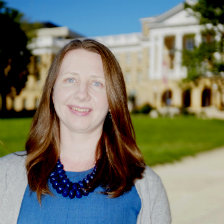
Eleanor Neff Powell
I am an Assistant Professor in Yale University's Department of Political Science and Resident Fellow in the Institution for Social and Policy Studies and Center for the Study of American Politics. My research focuses on the U.S. Congress, political parties, and the policy-making process with a particular emphasis on exploring the role of money in politics. I received my A.B. in Politics and Political Economy from Princeton University (2004) and Ph.D. in Political Science from Harvard University (2009).
My book project, Where Money Matters in Congress, examines the influence of money on the internal politics of Congress and the biases it has for the policy-making process. Disagreements over the influence of money in Congress between the scholarly academy and the beliefs of political practitioners and average citizens over the role of money in American politics has never been wider. On the one hand, politicians, journalists, and political observers regularly bemoan the enormous influence of money noting the tremendous time and energy politicians spend fundraising, and the unprecedented amounts of money circulating in Washington. On the other hand, numerous academic studies repeatedly fail to find any evidence of such influence. These contradictory and strongly held positions about the role of money in American politics appear on the surface to be irreconcilable. I explain these differences by showing that academics have largely looked in the wrong place in their evidentiary search. I find that money matters in Congress by determining how much influence your elected representative has over public policy, and that it matters a tremendous amount. I use quantitative analysis, congressional interviews, and archival work to explore this evolving influence of money over time.
A related paper from this project, "Dollars to Votes: The Influence of Fundraising in Congress" uses new data on campaign fundraising events in which one member of Congress serves as a "headliner'' to draw donors to an event benefiting another member. These headlining events effectively circumvent contribution limits, and muddy the waters for scholars trying to investigate influence and access. While considerable academic attention has been devoted to assessing the direct impact of the campaign contributions of outside actors on legislative voting behavior, little to no attention has been paid to assessing the impact of fundraising members of Congress do for each other. Rather than a traditional vote buying model, I propose a more subtle mechanism of influence in which members who receive help are just slightly more likely to support the fundraising member's legislative priorities. Using a new dataset of headlining appearances at congressional fundraising events, and a new measure of legislative support, I show that controlling for the ideological similarity of their past voting records, a Democratic Congressman is 5.5% more likely to vote for a bill for each fundraising event the bill's sponsor has headlined for them in the past (Republican Congressmen are 2.5% more likely). These results show a strong relationship between fundraising assistance and subsequent legislative voting behavior and suggest potentially serious consequences for representation.
In addition to my solo authored projects, I'm actively involved with a number of collaborative projects on congressional policy-making. In ``Congressmen in Exile: The Politics and Consequences of Involuntary Committee Removal", (joint with Justin Grimmer - forthcoming at The Journal of Politics), we show how preferred committee assignments act as an electoral subsidy for members of Congress--empowering representatives' legislative careers. When holding the preferred committee assignments, legislators are able to focus more on legislative activity in Washington. But when the subsidy is removed, legislators are forced to direct attention to the district. To test our theory of legislative subsidy, we exploit committee exile--the involuntary removal of committee members after a party loses a sizable number of seats, and the losses are unevenly distributed across committees. We show that exile has only limited electoral consequences, but this is partly due to compensatory efforts--exiled legislators shift attention away from Washington and towards the district. In our second paper on this project, we hope to exploit the process of committee exile to answer questions about the influence of money in politics by examining whether corporate contributions from a given industry to a member change after he or she is exiled. A drop in an industry's giving would suggest donors are primarily seeking access to the committee's policy-making process, whereas constant giving would suggest donors are mostly interested in helping to hold the seat of a friendly legislator.
In "Driving Support: Workers, PACs, and Congressional Support of the Auto Industry" ( joint with Ryan Moore and Andrew Reeves--Forthcoming, Business & Politics), we examine how the auto industry garners broad congressional support from across the ideological spectrum. In "Understanding the Party Brand'', currently under review and joint with Daniel Butler, we conduct a relatively rare set of survey experiments on legislators that show the circumstances under which party leaders exert pressure on their members and how the party brand can directly affect the voting decisions of legislators.
In addition to my continuing research on the congressional policy-making process, I am actively involved in a diverse array of on-going research projects ranging from Comparative Legislative Studies to American Public Opinion to Political Methodology. While I primarily study legislative institutions, political parties and elite behavior in the American context with a particular focus on the U.S. Congress, the search for institutional variation occasionally takes me further afield to the comparative context. To that end, and particularly looking to exploit the unique circumstances of partisan institutional development found only in new democracies, I've written two papers exploring electoral volatility, new party entry and party switching behavior (the first with Joshua A. Tucker was published in the British Journal of Political Science, and the second with Joshua A. Tucker and Daniel Kselman is currently under review). In ``How Not to Lie Without Statistics'' (joint with Gary King) we highlight, and suggest ways to avoid, a large number of common misunderstandings in the literature about best practices in qualitative research, while attempting to construct specific practical guidelines that can be used to improve actual qualitative research designs. Lastly, recently published in PS: Political Science & Politics, was ``Revisiting Public Opinion in the 1930s and 1940s'' (joint with Adam Berinsky, Eric Schickler, and Ian Yohai) in which we introduce a new dataset, discuss the methodological issues therein, and demonstrate some practical applications.
My book project, Where Money Matters in Congress, examines the influence of money on the internal politics of Congress and the biases it has for the policy-making process. Disagreements over the influence of money in Congress between the scholarly academy and the beliefs of political practitioners and average citizens over the role of money in American politics has never been wider. On the one hand, politicians, journalists, and political observers regularly bemoan the enormous influence of money noting the tremendous time and energy politicians spend fundraising, and the unprecedented amounts of money circulating in Washington. On the other hand, numerous academic studies repeatedly fail to find any evidence of such influence. These contradictory and strongly held positions about the role of money in American politics appear on the surface to be irreconcilable. I explain these differences by showing that academics have largely looked in the wrong place in their evidentiary search. I find that money matters in Congress by determining how much influence your elected representative has over public policy, and that it matters a tremendous amount. I use quantitative analysis, congressional interviews, and archival work to explore this evolving influence of money over time.
A related paper from this project, "Dollars to Votes: The Influence of Fundraising in Congress" uses new data on campaign fundraising events in which one member of Congress serves as a "headliner'' to draw donors to an event benefiting another member. These headlining events effectively circumvent contribution limits, and muddy the waters for scholars trying to investigate influence and access. While considerable academic attention has been devoted to assessing the direct impact of the campaign contributions of outside actors on legislative voting behavior, little to no attention has been paid to assessing the impact of fundraising members of Congress do for each other. Rather than a traditional vote buying model, I propose a more subtle mechanism of influence in which members who receive help are just slightly more likely to support the fundraising member's legislative priorities. Using a new dataset of headlining appearances at congressional fundraising events, and a new measure of legislative support, I show that controlling for the ideological similarity of their past voting records, a Democratic Congressman is 5.5% more likely to vote for a bill for each fundraising event the bill's sponsor has headlined for them in the past (Republican Congressmen are 2.5% more likely). These results show a strong relationship between fundraising assistance and subsequent legislative voting behavior and suggest potentially serious consequences for representation.
In addition to my solo authored projects, I'm actively involved with a number of collaborative projects on congressional policy-making. In ``Congressmen in Exile: The Politics and Consequences of Involuntary Committee Removal", (joint with Justin Grimmer - forthcoming at The Journal of Politics), we show how preferred committee assignments act as an electoral subsidy for members of Congress--empowering representatives' legislative careers. When holding the preferred committee assignments, legislators are able to focus more on legislative activity in Washington. But when the subsidy is removed, legislators are forced to direct attention to the district. To test our theory of legislative subsidy, we exploit committee exile--the involuntary removal of committee members after a party loses a sizable number of seats, and the losses are unevenly distributed across committees. We show that exile has only limited electoral consequences, but this is partly due to compensatory efforts--exiled legislators shift attention away from Washington and towards the district. In our second paper on this project, we hope to exploit the process of committee exile to answer questions about the influence of money in politics by examining whether corporate contributions from a given industry to a member change after he or she is exiled. A drop in an industry's giving would suggest donors are primarily seeking access to the committee's policy-making process, whereas constant giving would suggest donors are mostly interested in helping to hold the seat of a friendly legislator.
In "Driving Support: Workers, PACs, and Congressional Support of the Auto Industry" ( joint with Ryan Moore and Andrew Reeves--Forthcoming, Business & Politics), we examine how the auto industry garners broad congressional support from across the ideological spectrum. In "Understanding the Party Brand'', currently under review and joint with Daniel Butler, we conduct a relatively rare set of survey experiments on legislators that show the circumstances under which party leaders exert pressure on their members and how the party brand can directly affect the voting decisions of legislators.
In addition to my continuing research on the congressional policy-making process, I am actively involved in a diverse array of on-going research projects ranging from Comparative Legislative Studies to American Public Opinion to Political Methodology. While I primarily study legislative institutions, political parties and elite behavior in the American context with a particular focus on the U.S. Congress, the search for institutional variation occasionally takes me further afield to the comparative context. To that end, and particularly looking to exploit the unique circumstances of partisan institutional development found only in new democracies, I've written two papers exploring electoral volatility, new party entry and party switching behavior (the first with Joshua A. Tucker was published in the British Journal of Political Science, and the second with Joshua A. Tucker and Daniel Kselman is currently under review). In ``How Not to Lie Without Statistics'' (joint with Gary King) we highlight, and suggest ways to avoid, a large number of common misunderstandings in the literature about best practices in qualitative research, while attempting to construct specific practical guidelines that can be used to improve actual qualitative research designs. Lastly, recently published in PS: Political Science & Politics, was ``Revisiting Public Opinion in the 1930s and 1940s'' (joint with Adam Berinsky, Eric Schickler, and Ian Yohai) in which we introduce a new dataset, discuss the methodological issues therein, and demonstrate some practical applications.
Recent Projects:
- Book Manuscript: Where Money Matters in Congress
- "Dollars to Votes: The Influence of Fundraising in Congress"
- "Congressmen in Exile: The Politics and Consequences of Involuntary Committee Removal" (Joint with Justin Grimmer -Forthcoming, Journal of Politics)
- "Understanding The Party Brand" (Joint with Daniel M. Butler - Under Review)
- "Driving Support: Workers, PACs, and Congressional Support of the Auto Industry" (Joint with Ryan T. Moore & Andrew Reeves - Forthcoming, Business & Politics)
- "Crowded Space, Fertile Ground: Party Entry and the Effective Number of Parties" (Joint with Daniel Kselman and Joshua A. Tucker - Revise & Resubmit, Political Science Research and Methods))
- "How Not to Lie Without Statistics" (Joint with Gary King)
- "Revisiting Electoral Volatility in Post-Communist Countries: New Data, New Results and New Approaches" (Joint with Joshua A. Tucker - British Journal of Political Science)
- "Revisiting Public Opinion in the 1930s and 1940s" (Joint with Adam Berinsky, Eric Schickler and Ian Yohai, PS: Political Science & Politics 44(3): 1-6.)
- "Money in Exile: Corporate Campaign Contributions and Committee Access" (Joint with Justin Grimmer)
- "Pure Position-Taking in the U.S. House of Representatives"
- "Bias and Strategic Abstention in Congressional Roll Call Voting"